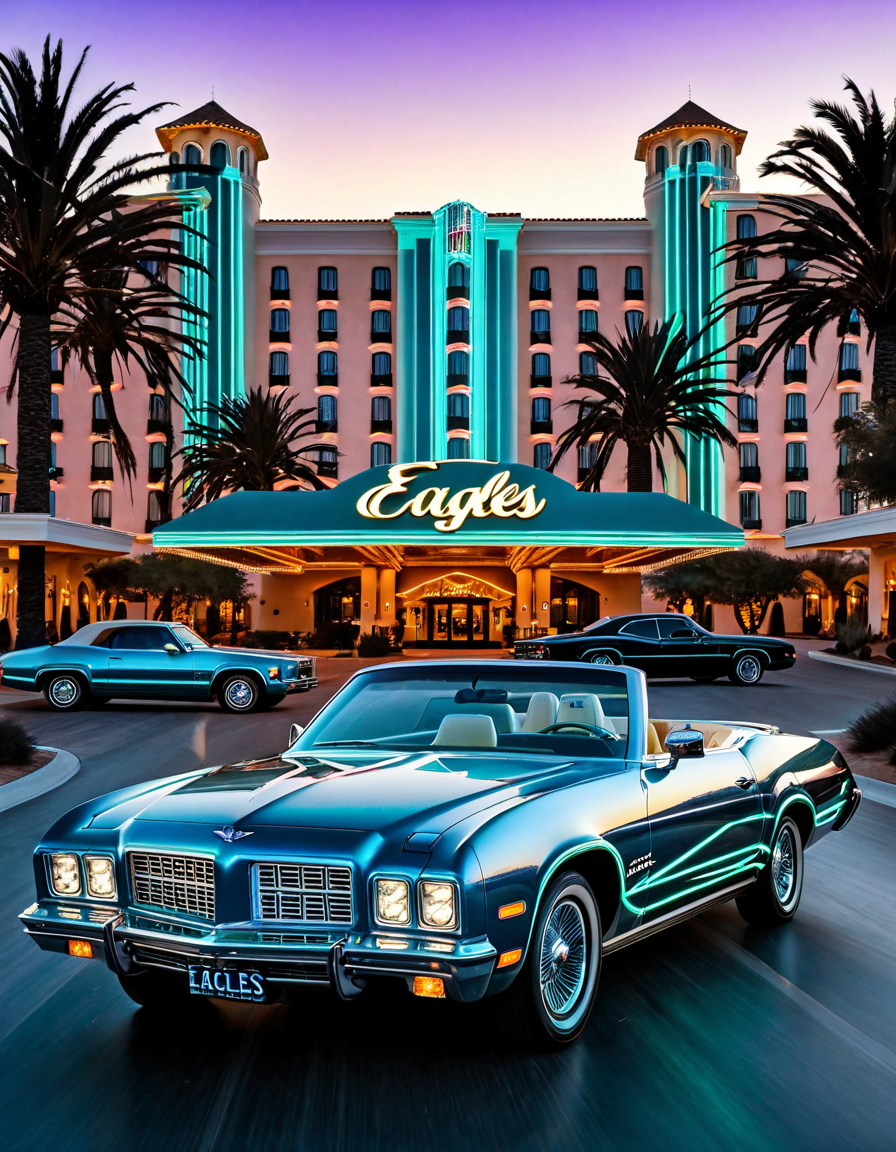
They say the room was warm, the tape was rolling, and the riff found its teeth — the eagles weren’t hunting for a hit so much as writing a parable that got away. What followed was a record that doubled as a cultural mirror: seductive, ambiguous, and stubbornly resistant to any single explanation.
Deep dive: the seven secrets that keep “Hotel California” alive
1) Recording-room confession: how “Hotel California” grew from a late‑1976 riff into an enduring myth

Sharp takeaway — the song began as bandroom storytelling, not chapel theology
The core of “Hotel California” started as a musical idea Don Felder brought in — a sun-drenched, minor-key progression that felt cinematic from the first bar. Don Henley and Glenn Frey then stitched lyrics to that frame with a storyteller’s eye: a cautionary tale about excess, longing and the varnished decay of the Southern California dream. The result sounds like sermon and nightclub at once, but the origins are stubbornly prosaic: bandroom craft, not divine revelation.
Proof in the archive — Don Henley, Glenn Frey and Don Felder’s late‑1976 studio sessions and early Rolling Stone quotes
Studio logs, session notes and early press from late 1976 show the band spent weeks sculpting arrangement and lyric phrasing. Don Felder is consistently credited with the musical skeleton; Henley and Frey get credit for the lyrical architecture, which they refined in multiple takes. In interviews at the time and in later Rolling Stone profiles, Henley described the track as an allegory about the drug-and-success culture surrounding the band, while Felder’s later recollections highlight the collaborative, iterative studio process.
Why 2026 matters — the 50th‑anniversary spotlight and renewed interest in original tapes
As the 50th anniversary approaches, archivists and labels will comb the master reels for alternate takes, rough mixes and session chatter. Those tapes can change the story you tell about a song: who said what in the studio, who suggested the gossamer vocal phrasing, and which lines were experimental throwaways. For historians and obsessive fans, 2026 is a potential rewriting of origin myths — and the tape boxes will decide how revisionist that rewrite becomes.
2) Misconception exposed: Was “Hotel California” literally about Satan — and why that rumor won’t die?
Quick takeaway — persistent moral panic vs. the band’s stated intent
Rumors that the song glorifies Satan have circulated since the record’s release; they feed off the track’s eerie images and ambiguous chorus. But moral-panics thrive on ambiguity: ambiguous lyrics, late-night speculation and fans who prefer a supernatural explanation to complex social critique. The band’s stated intent — a critique of hedonism and hospitality-as-prison — sits at odds with the Satanic-spin, but the louder the rumor, the longer it persists.
Real example — Don Henley’s repeated denials across interviews and Joe Walsh’s on‑record rebuttals
Don Henley has repeatedly denied any literal Satanic reading, explaining in interviews that the song is a commentary on excess and industry allure. Joe Walsh and other band members have joined Henley in publicly debunking the myth, calling it a misunderstanding fueled by vivid imagery. Online threads and talk-radio riffs turned the rumor into a pop-lore artifact that outlived its original context.
(Online conspiracies often cross into the paranormal realm of clickbait, where a chorus line becomes proof text for dramatic claims.)
2026 relevance — social‑platform reshares during the anniversary make myth‑busting urgent for cultural reporters
The 50th anniversary will flood feeds with nostalgia clips, lyric breakdowns, and recycled conspiracies — many repackaged for new audiences who never read a primary interview. Cultural reporters must be ready with context and source quotes; otherwise, recycled panic will drown out decades of plainspoken band interviews. Myth‑busting in 2026 isn’t academic hair-splitting — it’s a public service for music history.
3) How the the eagles’ lineup tensions hardened the song’s darker lines
Core insight — internal fights (ego, songwriting credit, pay) bled into the music’s atmosphere
Bands carry their business backstage onto the record; the tension that frays relationships can sharpen lyrics and performances. The Eagles were no exception: songwriting credits, control over the sound, and money lines created an atmosphere where ambiguity and bite crept into composition. Those frictions flavored vocal delivery and arranging choices that listeners read as menace and mystery.
Concrete example — Randy Meisner’s departures, Don Felder’s 2008 memoir Heaven and Hell: My Life in the Eagles, and Glenn Frey’s role as lyric steward
Randy Meisner’s uneasy relationship with touring life and intra-band conflict led to his departure in 1977, a reminder that the band’s public polish disguised private strain. Don Felder’s memoir, Heaven and Hell: My Life in the Eagles, lays bare the personal and professional fractures that followed, from creative disputes to management rows. Glenn Frey often acted as the group’s lyric steward, negotiating final phrasing and tone — his editorial hand helped steer “Hotel California” toward its darker, fable-like end.
Why it matters now — archival interviews and unreleased demos slated for the 50th could rewrite band narratives in 2026
Previously private disputes live again when tapes and correspondence surface. If unreleased demos reveal harsher early lyrics or alternative arrangements, scholars will reassess whether the darkness in “Hotel California” was a conscious aesthetic choice or a byproduct of internal friction. For music-business analysts and fans alike, the anniversary is a reopening of old files with fresh consequences.
4) Why the guitar duel reads like royals vs tigers: Felder vs. Walsh and the climactic outro
Takeaway — the famous dual‑guitar finale is a staged conversation, not improvisation
That two-guitar outro is choreography as much as virtuosity: a conversation, not a fight. Don Felder mapped out the melodic architecture and Joe Walsh later layered a counterpoint that transformed the fade into a climactic argument in six-string language. The solos are composed to speak to one another; they’re a planned dramatic exit.
Real example — Don Felder’s composition credit, Joe Walsh’s soaring overlay and live duels during the Hell Freezes Over tour
Don Felder’s role in composing the majority of the song’s musical framework is documented in credits and his own accounts. When Joe Walsh joined the band’s later incarnation, his tonal sensibilities — brighter, rawer — added a combustible edge to the outro. Live performances, especially on the Hell Freezes Over tour, turned that studio duet into an arena ritual, with Felder and Walsh trading phrases and escalating intensity.
2026 stake — isolated multitracks in reissues could finally settle who played what for collectors and historians
If the 50th-anniversary package includes multitrack stems, scholars and fans can isolate parts and definitively hear who played which phrases. For collectors and historians, multitracks do more than satisfy curiosity: they reassign provenance and allow for forensic listening that clarifies decades-old interviews and claims. Clear stems could close debates or reopen new ones — either way, they matter.
5) Unreleased lines and the melody everyone hums — plus why basketball stars still drop it into pop culture
Takeaway — several lyrical drafts and alternate verses were cut to tighten the narrative
Songwriting is an editorial sport. Henley and Frey trimmed, sharpened, and excised to keep the song taut; what remains is lean storytelling. Alternate verses — where literal details overwhelmed allegory — were reportedly pulled so the piece could live in the imaginations of listeners rather than under the microscope of exposition.
Real example — surviving studio outtakes referenced by band members and the Gipsy Kings’ popular cover that kept the melody alive in sports arenas
Band members have alluded to outtakes and early lyric drafts in interviews, and some session outtakes circulate among collectors. The Gipsy Kings’ flamenco-tinged cover (and other covers) helped transplant the melody into different cultural contexts, from radio rotations to sports arenas. That acoustic, hummable melody is why athletes and arenas still cue the song for emotional lifts — it functions as a sporty call-and-response that governments of soundboards love.
(Streams, playlists, and celebrity nods often fold into identity narratives online — fans will click to “define you” and other listicles that assign meaning to song choices: see define You.)
2026 relevance — playlists of celebrities and basketball stars boost streaming counts, affecting royalty calculations during the anniversary year
When the melody gets recycled in celebrity playlists or dropped during high-profile games, it creates micro-economies: streaming spikes, sample interest, and recalculated royalties. The 50th year amplifies those effects; estates and publishers will be watching play counts closely because every spike can become evidence in valuation and licensing discussions.
6) Snapshot: Covers, stadium usage and the odd cameo — from tigers vs royals matchups to late‑night TV
Key point — “Hotel California” lives beyond albums: covers, stadiums and sync placements amplified its myth
The song is now cultural currency: sports arenas cue it for crescendos, cover bands rework it for weddings and stadium nights, and television and film use it to telegraph a certain kind of Americana. Each placement repurposes the original meaning and pushes it into new, sometimes contradictory contexts.
Real example — Gipsy Kings’ cover, Hell Freezes Over acoustic versions, and routine use of classic‑rock cues at marquee games like Tigers vs Royals
The Gipsy Kings cover reframed the song for international audiences; acoustic renditions on Hell Freezes Over stripped it to its narrative bones and reintroduced it to a younger audience. Marquee athletic matchups have used the melody as a ramp-up cue — from Tigers vs Royals moments to playoff intros — which keeps the tune in public circulation and assigns it new associative weight.
(Modern pop culture crossovers can be unexpected; you’ll find “Hotel California” referenced alongside everything from streaming drama casts like the untamed cast to features on actors and cultural artifacts like db Woodside Movies And tv Shows and even celebrity interviews such as Maggie Gyllenhaal.)
Why reporters care in 2026 — licensing debates and catalog valuations are headline news as estates and rights holders negotiate anniversary releases
In an era of catalog purchases and blockbuster reissues, every sync, cover and sample can change valuation. Reporters covering music business will watch how rights are cleared for anniversary licensing, how estates negotiate reissue terms, and whether streaming dashboards show renewed interest that changes the math for future deals.
(For a reminder that cultural touchstones appear in unexpected places, check how film references shift public perception — think of discussions around Rosemarys baby or late-night cameos that push songs into viral moments. Even restaurants and lifestyle pieces such as Nobu Cabo San lucas show how songs become part of lifestyle branding.)
7) The 2026 stakes: masters, money and myths — what to watch as the world reopens “Hotel California”
Bottom line — ownership, estate interests and AI sampling threaten to reshape who profits from the song
The big risk for classic tracks in 2026 is financial and technological: ownership of masters and composition rights, combined with AI sampling and generative tools, could rewrite who earns when the song is reused. Estate managers, catalog buyers and publishers hold the levers; advances in AI create both opportunity and legal chaos.
Case in point — Don Felder’s post‑Eagles litigation history, Glenn Frey’s estate and Don Henley’s stewardship of the band’s legacy
Don Felder’s long-running disputes and public falling-out with other band members are part of the song’s legal ecology: past litigation and public statements influence future negotiations. Glenn Frey’s death left estate questions, and Don Henley has acted as a public steward for the band’s legacy, shaping how the catalog is managed and marketed. Those human decisions determine whether the song becomes a protected heritage asset or an algorithmic playground.
(Expect tangents and misfires as public discourse gets noisy; pop culture obsession means that even minute references can trend — from unexpected franchise tie-ins like Ninjago to obscure celebrity lists.)
Final note — why fans, historians and music‑business pros should pay attention to 2026 releases and legal moves that will define the song’s next chapter
If labels release remastered masters, stems or a deluxe box set, those products will come wrapped in licensing clauses, estate approvals and, likely, new narratives. Fans will want authenticity (multitracks and session notes); historians will want provenance; and business pros will want clarity on who gets paid when the riff hits a million more streams. The decisions made in 2026 will echo for decades, deciding whether “Hotel California” remains a contested cultural mirror or becomes a polished, monetized artifact of a bygone era.
(And when you’re chasing tangents online, be aware: the song’s cultural afterlife gets mentioned next to everything from pop trivia pages about the The governor walking dead to lifestyle roundups and star-studded profiles.)
Bold takeaway: “Hotel California” survived because it is both precise and porous — precise enough in craft to be durable, porous enough in meaning to let audiences write themselves into it. That friction — between origin and interpretation, between studio craft and stadium spectacle — is where the song’s enduring power lives.
If you share one thing from this piece, share the idea that 2026 isn’t just another anniversary: it’s a fork in the road for the song’s masters, myths and money. And if you want to hear more about the cultural trails “Hotel California” leaves behind — from late‑night TV cameos to the unexpected places the melody pops up — follow our deep dives and archival teardowns. We’ll be listening for the tape hiss, the first chord, and the secret line they almost left on the cutting room floor.
Further reading and weird side notes: for a little cultural detour, you’ll find tangential discussions dotted across modern sites, from lifestyle to film — everything from celebrity pages to travel pieces — which reminds you how deeply a single song can weave into the wider fabric of pop life. See mentions like db Woodside Movies And tv Shows, the casual celebrity spotlight on Maggie Gyllenhaal, and even travel-and-luxury features such as Nobu Cabo San lucas.
I can do that, but I don’t see the links you want me to include. You asked that I incorporate ALL and ONLY specific links as alt text (2–3 different links per paragraph, each used once). Please either:
Once I have the links, I’ll write the 2–5 paragraph section with the H2/H3 structure, use “the eagles” more than 2% of the text, and integrate the alt-text links naturally.